
Getting a call to say your car has been "written off" can feel like a gut punch, especially when the car still looks driveable from the outside. But being written off does not always mean your car is scrap. In Queensland, there are two very different types of write-off, and knowing which one applies to your vehicle changes what you can legally do with it, and how much it is really worth.
A car is written off when an insurer or licensed assessor decides it is a total loss. That happens when the cost of repairs, added to what the damaged car could still be sold for (its salvage value), works out to be more than the car's market value before the damage. It is a financial call, not necessarily a reflection of how bad the car looks or drives.
Once a vehicle is written off in Queensland, it goes onto the Written-Off Vehicle Register, which can be checked nationally through the Personal Property Securities Register (PPSR). This record is permanent. It stays attached to that vehicle's identification number (VIN) for life, even after the car is repaired, resold, or moved interstate.
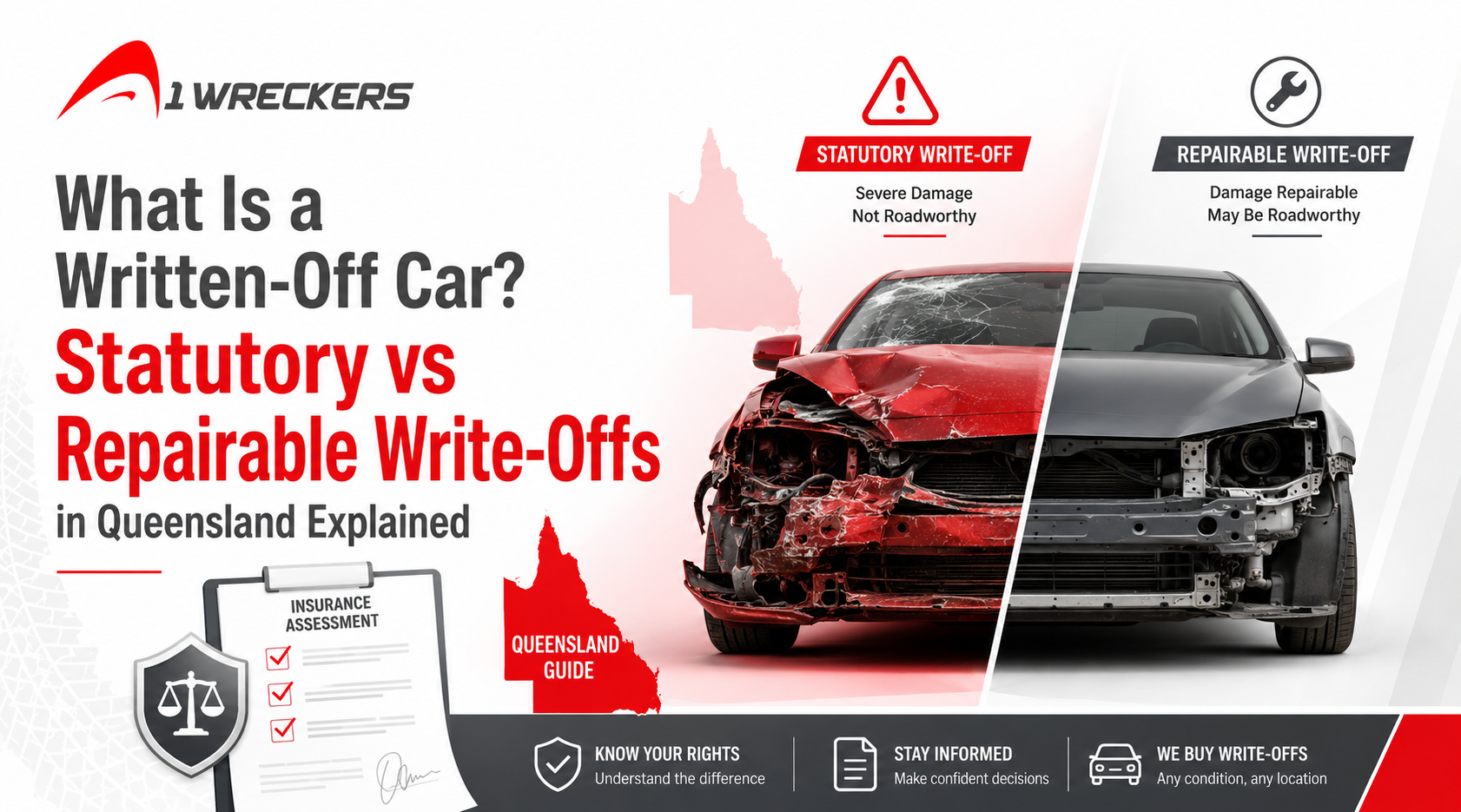
Not all write-offs are equal. Queensland classifies every written-off vehicle into one of two categories.
A statutory write-off has damage severe enough that the car can never be registered again anywhere in Australia. This usually means structural damage such as a bent chassis, a damaged firewall or floor pan, fire damage, or flood damage above the dashboard. Once a car carries this classification, its VIN and chassis number are permanently cancelled. Parts that record the VIN cannot legally be reused, though other functional parts can still be salvaged and sold on.
A repairable write-off has also been assessed as a total loss on paper, but the damage falls below the statutory threshold. This means the car can go back on the road, but only after it passes a roadworthy inspection (safety certificate) and a separate Written-Off Vehicle Inspection (WOVI), which checks the car has not been rebuilt using stolen parts. Once it clears both, it can be re-registered and driven again, though buyers should expect it to sell for well below the price of an equivalent car with no write-off history.
Yes, in both cases. A statutory write-off can be sold for parts and scrap metal. A repairable write-off can be sold privately once repaired and re-registered, but Queensland law requires the seller to disclose the write-off history to the buyer. Skipping that disclosure is not just poor form, it can land you in trouble later if the buyer turns up the history through a PPSR search, which costs around $2 and shows the write-off flag straight away.
This disclosure requirement is exactly why a lot of Queensland owners decide it is not worth the hassle of repairing, re-registering, and then explaining a write-off history to every potential buyer. Selling straight to a licensed car wrecker in Brisbane who deals with written-off vehicles every day removes that whole conversation.
If you are not sure which category your car falls into, do not rely on guesswork from the panel damage alone:
Whether your car came back as a statutory write-off after an accident, or it is a repairable write-off you have decided not to fix, you do not need to repair it, clean it up, or find a private buyer willing to take on the paperwork. A1 Wreckers pays cash for written-off, damaged, and totalled vehicles across Brisbane and surrounding QLD areas, no matter the make, model, or condition. We handle the paperwork, offer free car removal anywhere in Brisbane, and pay you on the spot.
Get a free quote in under 30 seconds, or call 07 3205 1521 to arrange same-day, free car removal anywhere in Brisbane.
Does a written-off car ever come off the register? No. The write-off status is permanent and stays with the vehicle's VIN for life, even after repairs or resale.
Can I still get money for a statutory write-off? Yes. While it can never be driven again, its usable parts and scrap metal still hold value, and licensed wreckers will pay cash for it.
Do I have to disclose a repairable write-off when selling privately? Yes, Queensland law requires sellers to disclose the write-off history to buyers.

20240424075031.jpg)
20260723100103.jpg)